Regional Architecture Association - Reflections Experience - Part 3 — Architectural Practice as a Trust Mechanism
Dear Readers,
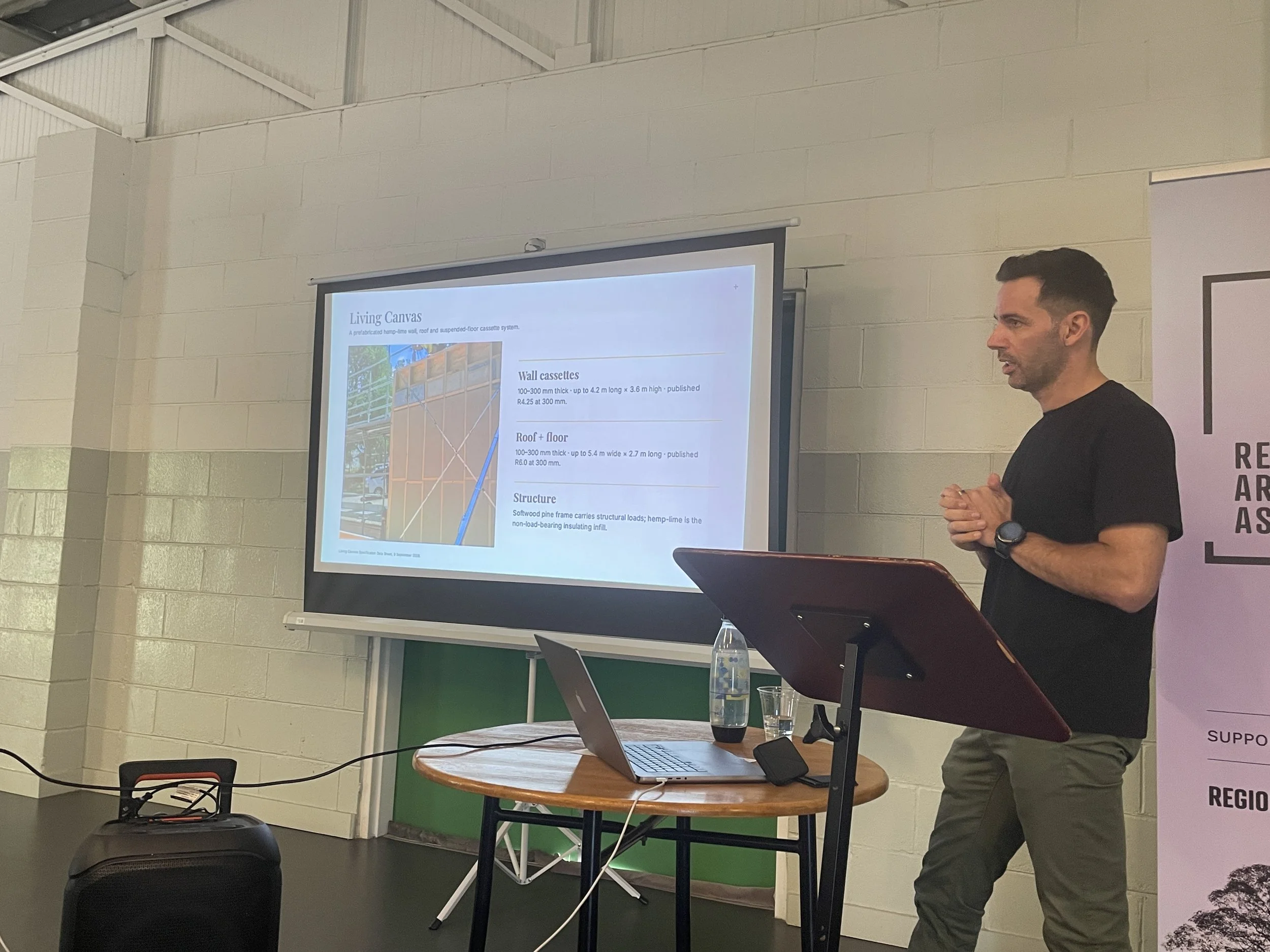
After a wonderful lunch put on by The Youthie, our fifth speaker was Chris Ball of Otetto, who introduced us to their prefabricated hempcrete panel system, Living Canvas.
Otetto is based in Ashby, NSW, and has primarily been supplying regional residential projects. Ball’s proposition was straightforward:
“This product has been developed in response to the market – it is thirsty for speed! The market is begging for more housing!”
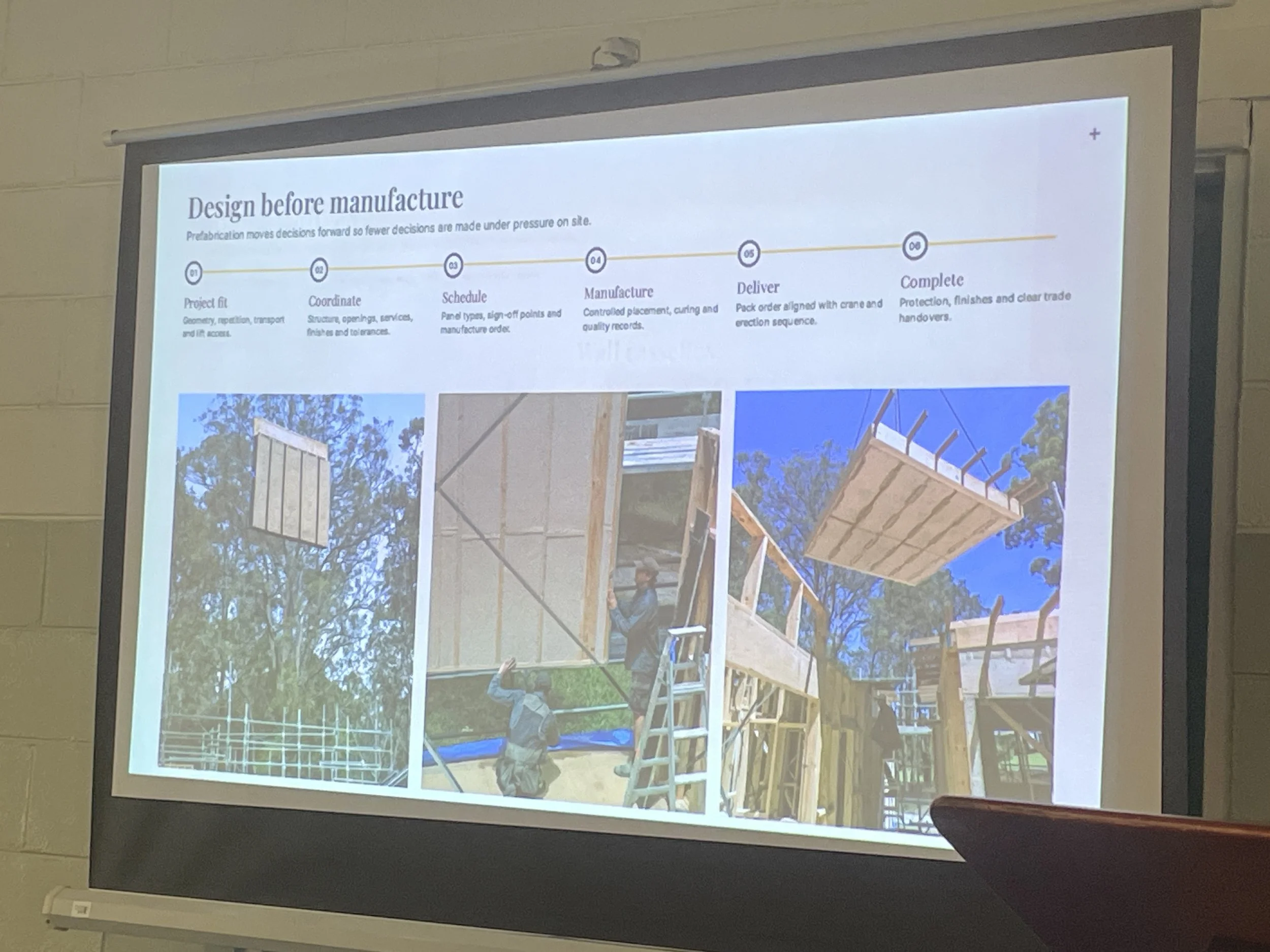
The system combines conventional timber framing with bound hempcrete panels, with the potential to be used for walls, floors and roofs.
What interested me wasn't so much the product itself, but why prefabrication might make particular sense in regional areas.
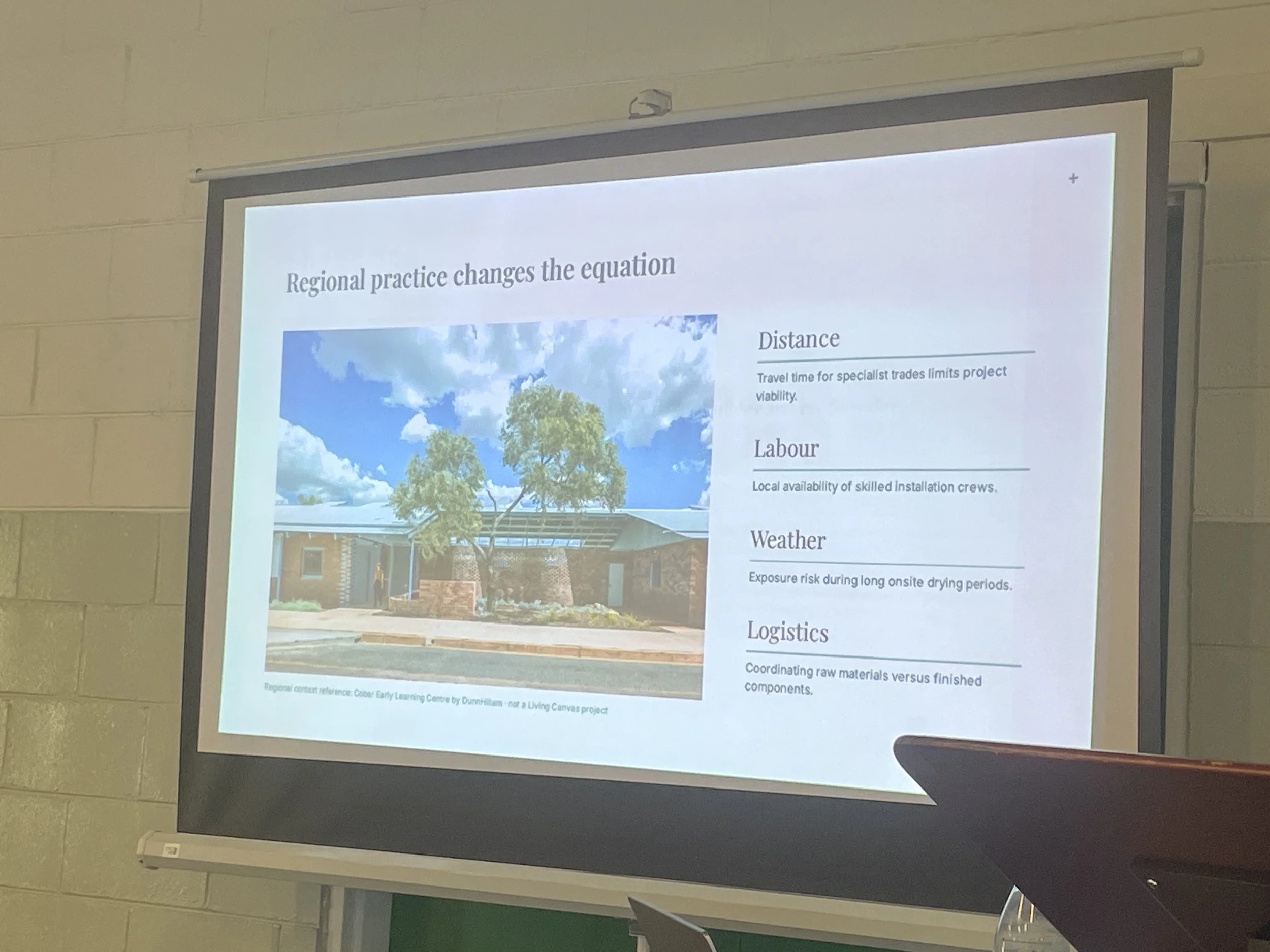
- Distance
- Labour
- Weather
- Logistics
These factors have a much greater impact when materials, trades and specialist skills have to travel long distances.
A system that can reduce the amount of work required on site, shorten construction periods and increase the capacity of local builders to deliver more projects certainly has potential. Not to mention the thermal mass, and R value it holds (including the up to R4.5 for 300mm wall or R6.0 for a roof / floor panel, has a thermal mass and holds a NRC coefficient of less that 0.69).
The catch? Some of these panels weigh around 1.7 tonnes. So perhaps the regional solution isn't quite as simple as “prefabrication = better”! There is give and take with all innovations.
For clarity, my notes are not an endorsement of the product - reader beware and do your own due dillegence. That aside, the idea of finding ways to build more efficiently, with less labour on site and greater certainty, and from our own exposure to “country tax” has benefit in regional Australia.
Architecture as an act of repair
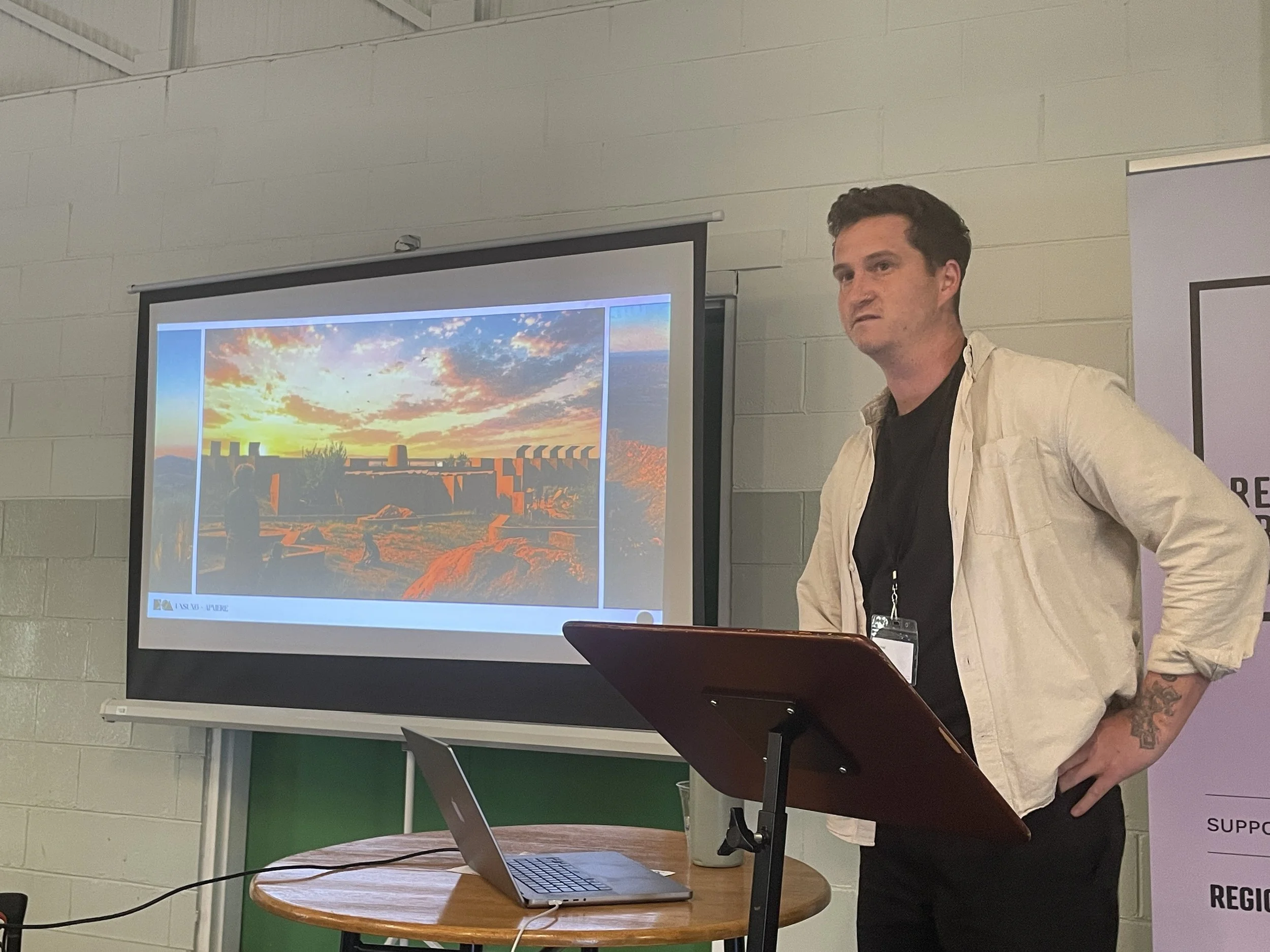
Our next speaker was Thomas Jager, a recent architecture graduate and recipient of the 2026 NSW Architects Medallion for his thesis project Unsung – Apmere.
Jager shared his speculative community housing project at Irrkerlantye / White Gate Town Camp, on the outskirts of Mparntwe / Alice Springs.
His starting point was that architecture could be an act of repair. In Jager’s words, “there is a clash of two cultures, and they don’t meet as well as either would like – there is an unspoken apartheid in Alice Spings.” Rather than assuming what “home” should mean (in a post-colonial way limiting our imagination on what the future could hold), Jager spent time visiting the community and listening. One of the strongest observations was that people had often not been asked what they wanted from public housing. What they wanted first was the opportunity to sit on the ground and be listened to, so that their culture and language could be maintained.
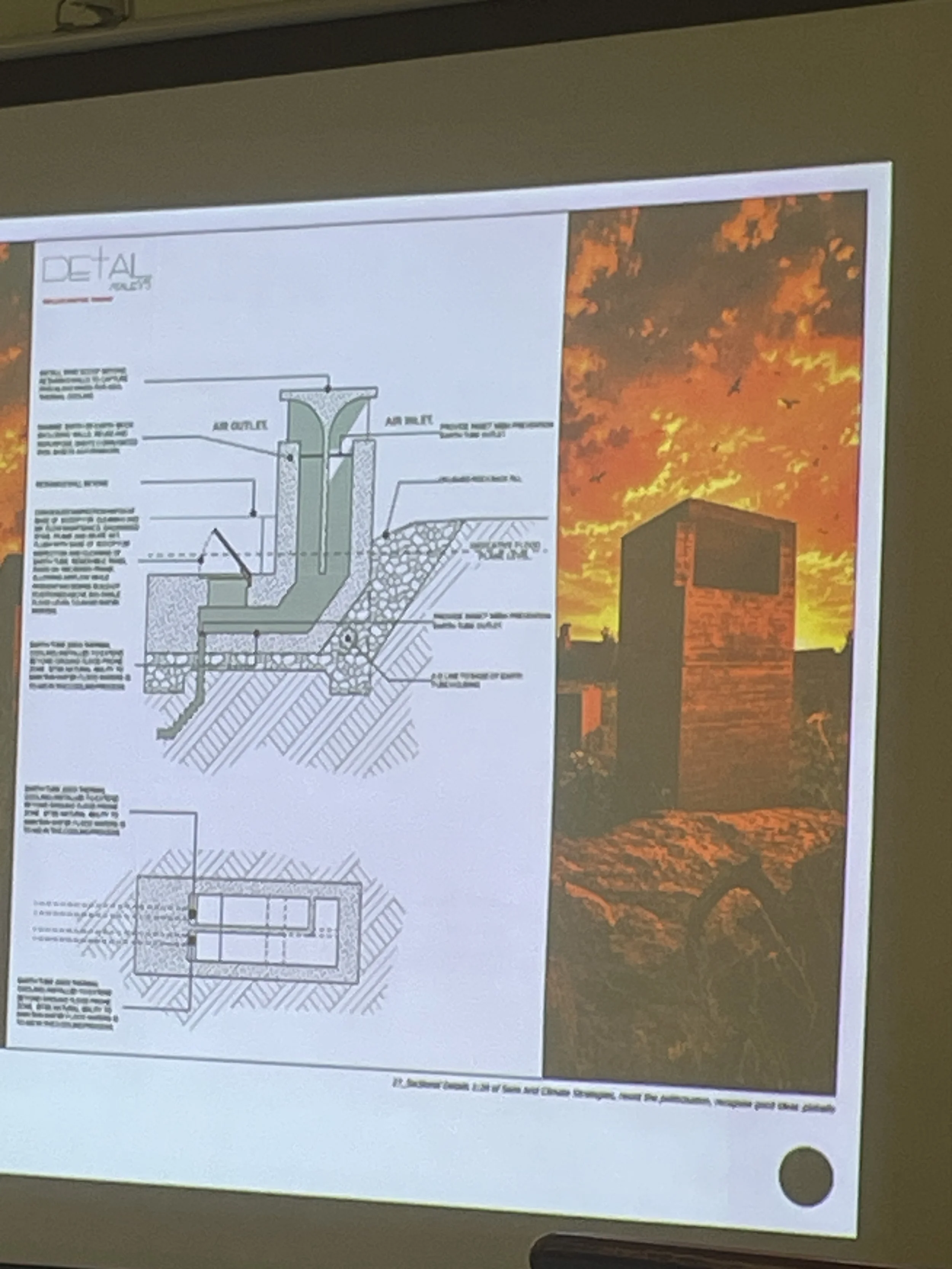
The resulting design explored low-tech, locally appropriate solutions — rammed earth, concrete, passive solar and wind design, shaded communal spaces and water collection.
Even the method of communicating the architecture changed.
Rather than relying solely on conventional architectural drawings, Jager used ideograms and painterly images to explore stories, weather, water, kinship, dreaming and relationships to Country.
At the end of the project, the community asked him:
“So whatareya? Missionary, mercenary or misfit?”
This question struck him cold. However, on what architecture offers:
“Architecture is about walking alongside people, and guiding people on what their spaces might become.”
It might take an entire career before having this realisation.
Architectural practice is a trust mechanism
The conference concluded with a panel hosted by RAA President Tim Lee, bringing together Jager, Ball, Hollis and Macchia. The recurring theme was trust.
And suddenly, a lot of the conference made sense. Paulo Macchia observed that procurement can make or break a project from the outset. It establishes the tone of the relationship between client and architect — transactional, or mutually beneficial.
Trust has to be earned by consistently explaining what we do and why we do it.
Jonathon Temple put it more bluntly:
“Trust is hard to earn, and easy to lose.”
Regional communities may arrive at a project carrying years of experiences — good and bad — with government, consultants and other institutions. Trust therefore isn't something a consultant can simply assume will be there when they arrive. Sometimes you have to start from scratch.
For Thomas Jager, the answer was listening. You can't know all the issues. You can't assume anything. One positive interaction won't undo years of disappointment, but it can be a beginning.
Melissa Hollis took the idea of trust somewhere else again — architectural registration itself can be understood as a trust mechanism.
Hollis remarked, “Needing a client-architect agreement checklist is a sign that the profession lacks trust with the public”, perhaps this truth is the elephant in the room for Victorian Architects (at the time of writing, the Architects Regulations have been updated to include a working with your architect checklist for clients on Class 1 and 9 projects).
Our obligation is to be accountable, uphold professional standards and communicate openly with consumers. Perhaps the need for increasingly prescriptive client information and agreements is itself a sign that the profession has some work to do in rebuilding public trust.
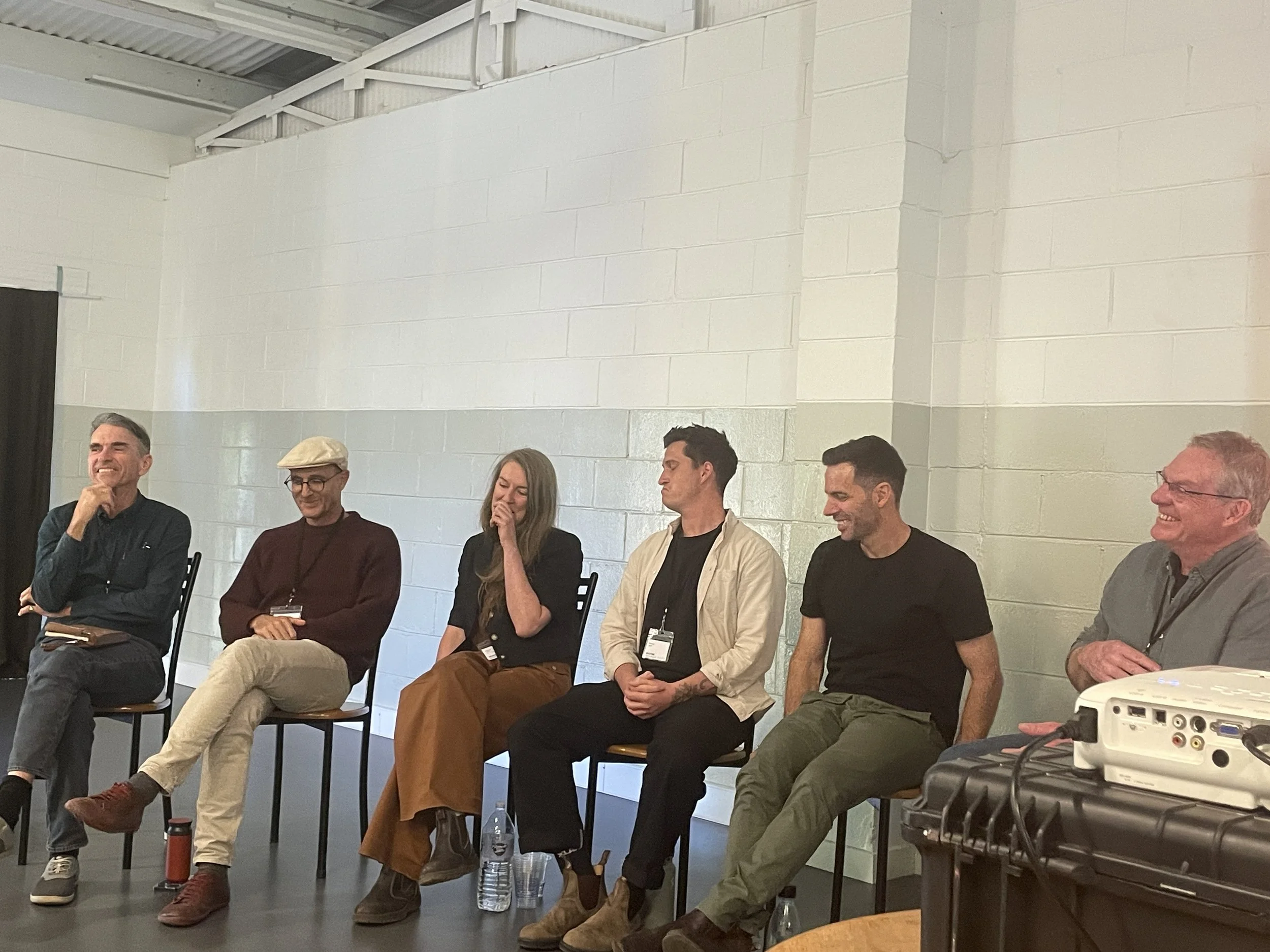
Jonathan Temple, Paulo Macchia, Melissa Hollis, Thomas Jager, Chris Bell and Tim Lee
Chris Ball brought it back to service: trust is demonstrated through consistency. For example builders face time pressures and market needs that creep their way into projects over the top of anything contractual.
And Macchia posed the question I found most provocative: architects are expected to act in good faith and carry significant risk — what happens if we ask the same of everyone else in the project?
He also challenged the idea that our role begins and ends with design.
I've been thinking about this since the panel: The services are the product. The completed building is the by-product. Our value is also in identifying and articulating risks that might otherwise remain unsaid.
And then Temple added one final provocation:
“Goodwill of all parties can’t always be relied on.” With a nod to Jager, “…[no disrespect to builders] but a client-architect agreement actually includes a builder as part of the relationships, and they may wish to be the mercenary not the missionary”.
Some quick takeaways
🚗 Having a road trip with a conference on the side is AWESOME
This was my first time in the Outback, and the experience of travelling with a close colleague, reconnecting with people across the Murray and getting outside my usual professional bubble was a big part of the conference for me. Being a little uncomfortable is a good thing.
I think the RAA is onto something with these Experiences. They are unusual, personal and very strongly connected to place.
📍 Regional projects require an acknowledgement of the tyranny of distance
Cartage, labour, specialist trades and access to knowledge all have real costs.
That means we need to think carefully about how we provide services — mixing face-to-face meetings, phone calls, email and Zoom where appropriate.
As Jonathon Temple put it:
“Only steamrollers care about weight.”
In regional projects, weight, distance and logistics all have consequences.
🛠️ Be a little un-fussy. Keep things refined.
The projects we visited demonstrated that regional architecture doesn't necessarily need to be complicated. Using familiar, robust building systems that can be sourced locally can give projects a better chance of success.
That doesn't mean avoiding innovation. It means meeting people where they are, doing less where less is needed, and being deliberate about where complexity actually adds value.
📋 Procurement could be streamlined so we all benefit
This follows on from one of my earlier RAA Power in Community Conference takeaways: Governments get behind things they believe in. Could Macchia's research provide governments with a third way — a more streamlined and fair approach to procurement that helps projects, councils, consultants and communities succeed? Good outcomes are established early. Bad procurement can erode them just as quickly through wasted time, unnecessary tendering and opportunity cost.
And finally…
This was my second RAA Experience. No, you can't catch them all. But Reflections had the right balance of fringe events, speakers and site visits — all strongly connected to one another.
For me, the real strength was the connection between projects, people, place and architecture. The relationship between Cobar Shire Council and Dunn Hillam provided a genuine thread through the experience, making this conference feel particularly cohesive.
And perhaps that's what I've taken away most. Regional architecture isn't simply about designing buildings in regional places. It's about understanding the people, the place, the constraints, the history, the distance and the relationships — and then figuring out what architecture can actually contribute. That's a pretty good reason to get in the car and drive 9 hours over two days.
Thanks for coming along for the journey.
Cheers,
RH
Several photographs are courtesy of conference attendees, Dunn Hillam, Thomas Jager, and the author.
Redmond Hamlett is a Director (Projects) at WHDA Design & Architecture.